Photo by Gigi Pilcher for Sitnews. Vicki Pilcher, 16, of Ketchikan, Alaska ties a yellow ribbon in a tree to show support for her brother, Sgt. Zack Pilcher, USMC. Click on the image to go to the Sitnews article.
THE
YELLOW
RIBBON
HISTORY
A study by Gavin Finley MD
endtimepilgrim.org
October 2004

THE HISTORY OF THE YELLOW RIBBON:
The yellow ribbon is being displayed quite prominently in America these days. We see them tied around trees, on bumper stickers and before our eyes in all sorts of places. The yellow ribbons began appearing in large numbers after the Gulf War when we began sending large numbers of troops overseas to the Middle East.
AND THE SEARCH FOR ITS MEANINGWhat is the history behind the display of ribbons? For a long time ribbons have been kept as a symbol of remembrance of men and women who served in places far from home. They have been kept especially by wives, mothers and sisters in times of war in memory of their soldier boys abroad. They are powerful symbols of the ties that bind. Many military medals have ribbons attached to them.
Ribbons hold a very important place in the hearts and in the culture of the people of Western Christendom. Young women in former times would tie ribbons in their hair, the hair being a symbol of spiritual covering. They would wear a ribbon in a pledge of faithfulness to the one they love. In this they would be telling the world that they are remembering someone. The young lady was set apart and not available for courtship. They are remembering or waiting for someone special. Right now that special person had gone abroad and was not with them. But nevertheless, he was with them in spirit. And what's more, he will be back! He will be coming home to them some day. Until that day of his return they will wait for him. He occupies a special place in their hearts. They will remember him with their display of the ribbon. And when people ask about the ribbon they will tell others about the one who is being remembered.
We see the ribbons in other traditions as well. We present gifts to the ones we love. And around those gifts we wrap them up and tie ribbons around them. We do this to seal and to consecrate them until the one to whom the gift is given can untie the ribbon and receive what has been preserved for them. The ribbons are powerful symbols of devotion. They are emblems of the ties that bind.
Back during the times heyday of British Empire the parting of loved ones aboard ship was a very special time. Family members and friends would often be departing for places abroad. Often they would be away for long periods of time. As the ship prepared to pull away from the dock long lengths of ribbon or "streamers" were traditionally thrown from the dock to the people aboard the ship. It was a means of saying "bon voyage" and good-bye. As the ship pulled out to begin its voyage the ribbons would break. This often marked a long and wrenching experience of separation. Some of the ribbon would often be kept in memory of the parting loved one in the hope that they would see each other again.
Ribbons are kept in remembrance of those with whom we have a special bond. There is the sense that unless we remember these special ones and lift them up in a communal way they could become lost. This would bring us into a world of desolation. The ribbons are reminders of those whom we love, lest we forget them.
We see yellow ribbons on display all around us today. As a nation and as a community the yellow ribbons are out for all to see. We think of our soldiers, sailors, and airmen abroad. They have gone out from amongst us to places far away. Now they are in harms way. Many of them are facing our foes. We remember them. And we pray for their safe return.
Many are asking questions about the origin and the meaning of the yellow ribbons. It has been suggested that this is just a recent phenomenon. Some say that it dates back to 1981 with the return of the American hostages from Iran. But have we seen the yellow ribbon before then? Is there an earlier history of the yellow ribbons?
SHE WORE A YELLOW RIBBON
Some have traced the tradition back to the song "Round her neck she wore a yellow ribbon". This song has been around in various forms for 400 years. A film with a similar name, "She Wore a Yellow Ribbon" came out in 1949. It starred John Wayne. In this film it is also interesting to note the yellow bandannas worn by officers of the U.S. Cavalry in the 19th century. Is there a military connection to the yellow ribbons? We shall look into that matter later on in this article.
Here is a video of the song "She wore a yellow ribbon" sung by Lisa Ono.
There are several interesting elements to this song of legend. It may help us in our search for the meaning of the yellow ribbon. In the song, the lady in question testifies to others on behalf of her lover. He may be a soldier or a sailor going abroad. She wears the yellow ribbon to remember him. He was the one who tied the yellow ribbon in her hair. He did this because he would be leaving her for a period of time.
According to the song he tied the yellow ribbon in her hair for a reason. It was because of the bold look in her eyes. And it was because of her golden hair. In the symbolism there is a question about the girl that seems to be associated with the meaning of the yellow ribbon. Her lover is not entirely sure of her. There is also a reference to her golden hair. If the girl in question proves true this would seem to be a promise of a future crowning glory. We pick up this theme in the song as it was sung by the Andrews Sisters back in the 40's.
THE SONG, 'SHE WORE A YELLOW RIBBON'
By Russ Morgan
Sung by the Andrews Sisters
"Round her neck she wore a yellow ribbonHere in this song we perceive that this girl who wears the yellow ribbon has an opportunity to enter into a glorious destiny. And yet we also get the sense that for a time at least, she is being tested. She has a bold look in her eyes. Her lover is not sure of her heart.
She wore it in the winter
And the merry month of May
When I asked her, Why the yellow ribbon?
She said, It’s for my lover who is far far away.Far away, far away, far away, far away
She said, It’s for my lover who is far far away
Far away, far away, far away, far away
She said, It’s for my lover who is far far away.When, at first, she met a winsome Johnny
He wasn’t sure her heart was pure
Her eyes were far too bold
So, round her neck
He tied a yellow ribbon
He tied a yellow ribbon
‘Cause it matched her hair of gold
Hair of gold, hair of gold
He tied a yellow ribbon
‘Cause it matched her hair of gold
Hair of gold, hair of gold
He tied a yellow ribbon
For her eyes were far too bold.If, perchance, you spy a lovely maiden
And by her side, there walks with pride
A Johnny strong and gay
And round her neck there is a yellow ribbon
No matter how you love her
Please stay far far away,Far away, far away, far away, far away
No matter how you love her
Please stay far far away
Far away, far away, far away, far away
Her love is for another
So stay far far away
Far far awayFar far away
For her lover who is far far away."Now her lover has departed on a journey. He is far from her. But he will return. She has the opportunity to remain true while he is gone. Or perhaps she won't. She might choose someone else.
What will she do?
The song sends out an enigmatic message of warning concerning this girl with the yellow ribbon in her hair.
It is a yellow light of "caution". And that message, full of mystery and of wonder is this."Stay away from her!
She is promised to another!"TIE A YELLOW RIBBON ROUND THE OLD OAK TREE
We pick up the same theme in another popular song that came out in the latter part of the 20th Century. It was 'Tie a Yellow Ribbon Round the Old Oak Tree'. This song was written by Irwin Levine and L. Russell Brown. Here below is a YouTube video of this song.
"> The song appeared in 1973. This was just as the Vietnam War was winding down and many of the Vietnam vets were coming home, sadly, in many cases, to mixed receptions. In a very short period of time the song became extremely popular . In the lyrics we pick up on some other elements woven into the mosaic. We begin to see a larger story. The person in question is returning home after a long absence. Some of the themes we see here are reminiscent of certain well known Biblical stories such as the story of Hosea and Gomer as well as the story of the prodigal son. Here we see types and shadows with some rather profound prophetic meaning.
In the song we see a prodigal is returning home after a long absence. He is coming back to his family and friends. The wanderer with a checkered past is returning. We sense he is not the same man who left many years before. He is convicted in his heart about his past. The one who is returning is now a penitent and much wiser man. But as he gets closer to home he wonders how he will be received.
As the bus approaches the town of his family and friends his heart is filled with apprehension. His family knows he is returning. But how will he be received? There are so many things in his past. Things which he regrets. He has suffered through many trials and tribulations. And he has learned so many lessons. And so often he has learned them the hard way. But now that is all that is behind him. He is settled in his heart about the new direction in his life. He is coming home.
As the bus draws close to his family dwelling he doesn't want to look. Oh yes, they will be expecting him. But will they remember him with fondness? Will they even want to see him?
He doesn't want to look. So he asks the bus driver to look for him. If his family and friends want to see his face again there will be a sign. A yellow ribbon will be tied to a tree right there at his father's house.
Excitedly, the driver tells him to lift up his head and to look. There he sees a magnificent sight. The tree is full of yellow ribbons welcoming him home! He has been remembered after all. And the time of rejoicing has come.
THE YELLOW RIBBONS APPEAR DURING THE
IRAN HOSTAGE CRISIS AND DURING RECENT WARSIn our search for the history of the yellow ribbon some have concluded that the hostage crisis in Iran was the first time the yellow ribbons were seen across the country on a national scale. Gerald E. Parsons, writing in the 'American Folklife Center', has an interesting article on the history and the meaning of the yellow ribbon. He traces the first significant displaying of yellow ribbons back to 1981. This was the year which saw the end of the Iran hostage crisis. This was truly a joyous time of reunion and home-coming.
But have we seen yellow ribbons before the 1980's? Was there an earlier history? Have we seen yellow ribbons worn or displayed by a body of people during a national crisis perhaps during a war?
There does not seem to have been a record of any large national display of yellow ribbons during America's earlier wars. There were a few sporadic accounts of of yellow ribbons being tied to trees for returning servicemen during the Vietnam War. Be that as it may, there is no question that we are seeing a very significant national show of yellow ribbons today. We are seeing them all across the country. Why is this so?
Are we entering into some sort of climactic history?
And if this is the case, then who are the people of the yellow ribbon?
Has there been a national display of yellow ribbons in the earlier history of this company of people?
LOOKING FOR THE YELLOW RIBBON IN THE ENGLISH ROOTS OF AMERICA
Our search takes us back to America's early beginnings. There does not seem to be any connection of the yellow ribbon with non-European people groups. So our search takes us back to the European settlers who came to the New World. The yellow ribbon tradition must have been carried in with the white settlers. But which ones? Could the Pilgrims or the Puritans have brought it to America with them?Let us pause here and check out the Puritans. The Puritans were certainly the political and military movers and shakers of their time. And as the 1600's opened up they had visions of glory and high hopes for a brighter future, both in England and in the New World. But they found that the social, political, and ecclesiastical powers had closed their doors to them. The royal powers, the aristocracy, and the English Church were immovable. These English Reformers found themselves stuck in the status quo. The Puritans found themselves between a Rock and a hard place. They were finding it difficult to bring in the changes they so desperately wanted to see. The Reformation was proceeding at far too slow a pace for them. The Puritans now rising up in the English middle class were not ones to sit around waiting on ceremony. Their grievances were severe. And they wanted immediate action on their demands.
The Puritans soon became the leading spokesmen in Parliament. Under the able leadership of Oliver Cromwell, they boldly took their demands for political and religious reform to the king. An awful feud arose between Parliament, and King Charles. The king was supported by the English aristocracy and by the Bishops of the Church of England.
The Puritans wanted their national Church of England to be based on the newly emerging Biblical Christianity. They also wanted the king to address political issues. Interestingly enough, these concerns were related to 'taxation and representation'. They wanted the English Crown to share power with England's representatives of the people in Parliament. The Puritans became very influential in Parliament. An acrimonious war of words went on for some years between Parliament and King Charles I. It finally erupted into outright civil war. See this video.
THE YELLOW RIBBON AND THE
If we are looking for the yellow ribbon in the essential roots of America then we need to think outside the historical boxes of "American history" and "English history". Schoolteachers typically showcase the history of the Puritans as they arrive in the New World. And that is where they leave the story. But that does not give the complete picture. We need to trace the history of the Puritans forward, even to our time. And we need to trace the Puritans back into English history.
HISTORY OF THE PURITANS.The Puritans took to the battlefield against the king in the 1640's. It is when we begin to look into the English Civil War that we get our first big break. Right here on the battlefields of the the Puritan Revolution we notice something very interesting. We can clearly see the the yellow ribbons!
(See the video, 'Cromwell').
We see this heraldry being displayed quite clearly on the battledress of the soldiers of Parliament.
Indeed, the yellow ribbons are part of the heraldry of the Puritan Army!The painting below is a very famous work. It portrays in accurate and authentic detail a certain event which occurred during the English Civil War. It was painted by W.F. Yeames in the 1800's. It shows an interrogation of Royalist women and children. They are being questioned by Parliamentarians and military officers from Oliver Cromwell's Puritan Army.
If we take a look at the painting we notice something very interesting. The sergeant and the cavaliers in the Puritan Army along with the Parliamentarian investigators are all wearing a yellow sash.
Have we discovered the people of the yellow ribbon?
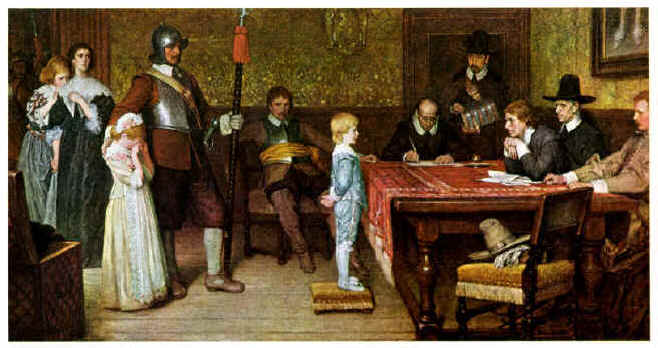
"When Did You Last See Your Father?"
by W.F. Yeames.
Click on the image for an explanation of details in the painting.In the painting above we see yellow sashes and ribbons. They are associated with a a special people, a company known as the Puritans. These people began their history with the English Civil War. Eventually many of them would migrate to the New World. These people would later go on to provide the main spiritual energy of an important sovereign nation known as the United States of America.
This image is from the video "Cromwell". It reveals America forming within the womb of England in the 1640's. This is 130 years before the actual birth of the nation in 1776. Here the Puritan Army goes to the Battle of Naseby singing hymns. John Bunyan, writer of Pilgrim's Progress, was with the Puritans in this decisive battle against King Charles I and his royalist army. Note the the cavalry officers in the Puritan Army wearing yellow ribbons and yellow sashes and the banner 'In God We Trust'. Quite clearly the yellow ribbons form an important part of the heraldry of the Puritans.
The soldiers of Oliver Cromwell's Puritan Army wore a yellow sash or yellow ribbon. These were worn onto the battlefield. The ribbons were worn as identifiers to mark out friend from foe in the chaos of battle. But was there a deeper sense of identity involved here as well?
The Puritan Army was raised up in a hurry. These were middle class people of limited means. They and their families would have taken a hand in preparing their own battle dress. The Puritan ladies, with husbands, brothers, or sons in the Puritan Army, would have been busy. They would have made up those yellow sashes for their menfolk. They were worn over their heavy brown battle coat.
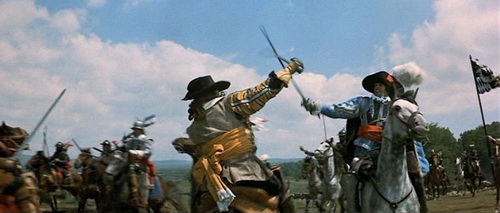
This image is from the video "Cromwell".
Note the the Puritan cavalry officer on the left wearing a yellow sash.So what is going on with these yellow ribbons? If they are the heraldry of the Puritans then what does this mean? Is this banner before the nations the heraldry of a people who have somehow lost their identity? We see them coming down some well known ancient paths. And judging from the recent reappearance of this heraldry of the yellow ribbons it seems that these same people are still marching on. Even today we see them lift up an ancient standard, a standard that happens to belong to a significant degree to the God of Israel. This is a matter for some pondering and perhaps some historical speculation. Can we connect the dots here?
It seems that the yellow ribbons can be traced back at least 400-500 years If that is the case then can we pause for a moment and think "outside the box"? When we do that this question arises. Are the people displaying the yellow ribbons today a continuation of the same people we saw wearing those yellow sashes back during the time of the English Civil War?
THE YELLOW RIBBONS IN FUTURE HISTORY
With our discovery of the Puritan connection to the yellow ribbons another question arises. Are the Puritans still with us? And if so, just where might we find these modern day Puritans in America today? What is their message? And, more importantly, what is their agenda? Is there a modern version of the Puritan Army? And what might be their ultimate destiny?Quite clearly the people of the yellow ribbon are still out there. And as we can readily appreciate they are still voicing the same desire to build a Godly Biblical society, even a 'nation under God'.
So, all that being understood, just how do they plan on achieving this goal?
And here is the most important question of all. Will they be successful?It seems that today's Puritans in America are displaying their historic yellow banners again.
Why? And what is the spirit behind all this spiritual and political energy?
And if the yellow ribbons are in fact Puritan heraldry then what does this mean for the nation?
America is the lone superpower now. How will her future actions affect world history?
The yellow banners are being lifted up again after all these years. Why?
Could it be that the modern American Puritans are on the threshold of their dream?
And as they raise their standards what might be really happening here?
Is this a rallying that might be expected before an epic and historic war?If such is the case then we may be about to enter into interesting times.
The western nations and their armies are back, back at the cradle of civilization,
Even as the principalities and powers are raging at the Euphrates River.
As we look down the road into the future we see a contest of Biblical proportions. (Rev. 9:14)Any year now we could find ourselves entering into times that try men's souls.
Those future 7 years would bring the epic conclusion to the Seventy Weeks Prophecy.If that is the case then how shall we respond?
Surely we can bring some word of exhortation.
And the cry should not just be the petition, "God bless America".
The call should also go out,. . . . . . . . . . . . . . . . . . . . . . . . . .