|
THE
The lunar cycles |
 |
|
|
moonsighting.com Crescent Moon (Muharram 1422) Photo provided by Rich Lobert Phoenix, AZ 03/25/01 at 7:24 PM Mountain Standard Time Moon age 25 hours 3minutes, Elevation 1.2 degrees |



LUNAR CYCLES
AND THE
HEBREW CALENDAR.
For an excellent online resource on the Hebrew calendar Claus Tondering
has
a website with some very informative
articles on calendars. There is also an excellent Jewish resource
giving valuable and helpful details on the Hebrew Calendar at
this website.
Like many calendars before Roman times the Hebrew calendar was a lunar-solar calendar. It was based upon the moon as well as the sun and the passage of the years. The first day of any given month was determined by the first sighting of the new moon. It was a wonderful calendar in that the phase of the moon gave an indication of the the day of the month. Anyone looking up into the night sky could get some idea of where they were in the month. If they had recorded the evening when they first saw the new moon then they had could mark down the ensuing day as day 1. And knowing that the lunar month was about 29.5 days they knew the month would run to either 29 or 30 days. With this they had a celestial calendar they could use with some fairly good accuracy from month to month. Amongst the populace at large they knew the month of the year in which the moon above them was shining. But not knowing precisely when the new moon would be seen they could not plan for, (say), a merchant or a military rendezvous on a certain day in the future with full assurance that all the parties would arrive at the agreed meeting place on the same day.
The key to the lunar-solar calendar was the sighting of the new moon. The new moon is not usually visible to the naked eye until it is 24 hours old. (See the photo above from the Islamic website moonsighting.com/moonphoto.html). And sometimes the new moon would be obscured by cloud. This is why the Hebrew calendar required confirmation by two or more witnesses. There were some definite vagaries in assigning the first day of the month.
THE ESTABLISHMENT OF A PURE SOLAR CALENDAR.
THE ROMAN EMPIRE INSTITUTES THE JULIAN CALENDAR.
The lunar calendar was used by Semitic peoples and many others from ancient times.
It was the Romans who in their iron-fisted way decided that they would make an improvement.
They would make their calendar fully predictive into the future by ignoring the lunar cycles altogether.
They would name and set forth the so-called "months" of the year with the names of their Caesars and other luminaries,
and assigning a certain number of days to each.
Then, since the year was close to being a quarter of a day over the 365 days they would
decree a leap year every four years and add an extra day beyond February 28 to make
February 29 the last day of the month that "leap" year.
Of course by doing this they would be totally ignoring the actual cycles of the moon.
It was during the reign of Julius Caesar that the Romans set forth their new calendar. It was based solely upon the annual passage of the earth around the sun. They considered the solar year to be so-close to 365.25 that this would be "good enough for government work". By this means they hoped to keep the equinoxes and solstices fixed to certain dates on their solar Julian calendar for some considerable time to come.
This worked fairly well for many centuries. But since the true solar year was actually 365.2422 days and the Julian calendar had been set at 365.25 days the Julian calendar was falling behind the proper dates expected for the equinoxes and solstices and the actual expected dates for the passages of the earth around the sun. The Julian calendar was falling behind by one day every 128 years. After many centuries the Julian calendar had come way out of proper synchronization with the solar equinoxes. Ecclesiastical authorities during the rule of Pope Gregory adjusted the Roman calendar and by dropping ten days off the Julian calendar, (and whilst keeping the weekly cadence the same), they reset the calendar to the solar passages. This was accomplished in 1582. Here is that story.
The Gregorian calendar is the internationally accepted civil calendar. It was introduced by Pope Gregory XIII, after whom the calendar was named, by a decree or a papal bull signed in February of 1582. The reformed calendar was adopted later that year by a handful of countries, with other countries following suit over the following centuries. The need for the Gregorian reform stemmed from the fact that the Julian calendar assumes time between vernal equinoxes is 365.25 days, when in fact it is about 11 minutes less. The accumulated error between these values had amounted to about 10 days when the reform was made in 1582, resulting in the equinox occurring on March 11 instead of March 21 and moving steadily earlier in the calendar. Since the equinox was tied to the celebration of Easter the reform in the solar calendar was a very necessary undertaking by the Western rulers. And the ruling power in the West at that time was the Roman Catholic Church.
The Papal Gregorian calendar is the one we have in the West today. It still tracks along with the annual orbit of the earth around the sun and continues with the same names of the month that had been set by the Romans. It remains a Roman style solar calendar. It still completely ignores the phases of the moon and runs completely independently of the lunar passages.
SOME SHIFTY BUSINESS AT THE COUNCIL OF NICAEA.
WE KNOW FROM THE SEVENTY WEEK PROPHECY THAT THE YEAR OF THE PASSION
CAME IN 32. A.D.. THE NASA LUNAR DATA
HEBREW CALENDAR WITH THE NISAN 14 DATE FOR PASSOVER THEREBY ASSIGNING THE
JULIAN DATES FOR THE EVENTS OF HOLY WEEK. THEN RUNNING BACK OUR PERPETUAL
CALENDAR INTO THE FIRST CENTURY TO THE WEEK OF THE PASSION WE DISCOVER THAT
THERE IS A MISMATCH OF OUR PERPETUAL CALENDAR WITH HOLY WEEK.
There is more to this story of the Julian calendar than we have been told. This solar Julian calendar did undergo
a very significant change at the Council of Nicaea in 325 A.D.. It is something we discover as we "connect the dots".
Whilst the Julian years and dates of the month were allowed to continue unchanged
we can discern that there was a big change to the days in a week AND the weekly cadence of the week.
Here is a brief background to the story.
JULIAN DATES FOR THE EVENTS OF HOLY WEEK. THEN RUNNING BACK OUR PERPETUAL
CALENDAR INTO THE FIRST CENTURY TO THE WEEK OF THE PASSION WE DISCOVER THAT THERE IS A MISMATCH OF OUR PERPETUAL CALENDAR WITH HOLY WEEK.
The earlier Roman week, the week that was used by Rome in the First Century, was not a seven day week. It was an 8 day week, in which the days were labeled A-H. This was called the Nundinal Cycle. The 9th day, the first day of the next Roman week was known as "Market Day". At the Council of Nicaea two significant changes were made to the Julian calendar. These changes did not affect in any way the faithful continuation of the Julian year and the running of the days of the month. But the layout of the week was profoundly changed and the cadence of the week as compared to the cadence of the Hebrew seven day week was quite different. Here is what happened.
1. the 8 day week was changed to a seven day week.Throughout the deliberations and calendar change at Nicaea the passage of Julian years, months, and days of the month remained undisturbed. And so in that regard the Roman Julian Calendar continued unchanged and the dates on the Julian calendar continued as the calendar of Western Christendom. This Julian calendar was upheld by the Roman Church throughout the Dark Ages and on into the medieval era. But, there is an untold story here. As we can see when we lift the covers, it is is a story subterfuge and intrigue.
2. This new seven day week was reset with the first day of the new seven day week honoring the pagan "Sun" god as "SunDay".
Let us lay out the facts. With our establishment of 32 A.D. as the Passion Year and what we can see is Biblically correct concerning the weekly layout of Passion Week we can start our search by looking at the Nisan 14 crucifixion date for the Passover of that year. The NASA lunar data will give us the Hebrew calendar and Nisan 14 date to help us lay out the the significant events of the Nisan 14 deathm the Nisan 15 burial on Unleavened Bread, and the Firstfruits Resurrection three days later on the first day of the Week following that epic Passover of 32 A.D. And then, after having put the pieces of the puzzle together we have the correct layout of Passion Week on both the hebrew and Julian calendars. Next, we compare this with the weekly layout we might expect when we run the Perpetual Calendar backwards into the first Century.
And what do we find? Something very very interesting. There is a significant mismatch between our present seven day week, (the one set in motion at the Council of Nicaea, and the seven day week of the Hebrew calendar we saw back in the first century.
See this PDF PowerPoint Presentation.
THE BEAUTY OF THE HEBREW LUNAR-SOLAR CALENDAR.
CAN THE BIBLICAL CALENDAR BE RESTORED? AND IS
THIS NECESSARY TO ACCURATELY ANTICIPATE THOSE EPIC
FUTURE EVENTS YET TO UNFOLD ON THE FALL FEASTS OF ISRAEL,
NAMELY THE FEAST OF TRUMPETS AND THE DAY OF ATONEMENT?
The early lunar calendars were agricultural calendars.
They were important for planting and harvesting.
The Hebrew calendar was set by the priests of Israel every spring.
The beginning month of the year was the month of Abib.
The word "Abib", meaning "ripe" was the moon which would see the ripening of the barley harvest.
This month of Abib was also the month of Nisan.
Nisan was determined by a celestial event. The Nisan moon was the first moon that would become a full moon after the passing of the spring equinox. Nisan thereby marked the first month of the year on the Hebrew calendar for the religious year. The Nisan moon, confirmed by the ripening of the barley harvest determined the month in which Passover would be celebrated.
The lunar calendar set forth years of 12 months or 13 months. In a span of nineteen years, the Metonic Cycle, there were seven years of 13 months. These were years in which the religious authorities would closely examine the new moon in the early springtime after the passage of 12 moons. The Sanhedrin or priests authorized to make this assessment would determine if that upcoming moon was going to come to fullness after the spring equinox or if the full moon would fall short of the spring equinox. If the full moon was going to come after the Spring equinox it would be declared to be the Nisan moon. If it was going to fall short of the spring equinox then it would be declared a second month of Adar, in effect a 13th month for that year. This extra or embolismic month would "push" the following moon, (which of course was now the moon of Nisan), up into the year. This in turn would to make for a late Passover, a late Pentecost, and late Fall Feasts for that year.
So in those years with an extra embolismic month called Adar 2), the Paschal month of Nisan would come later than usual for that year. Passover in such years would be celebrated well up into our Roman month of April. The next year Nisan would fall back 11.24 days and the following year back another 11.24 days until the moon after the 12th moon again failed to come to fullness before the spring equinox. Once again the lunar calendar would have to be adjusted. A second month would need to be inserted into the Hebrew calendar to bring it into proper alignment with the springtime. These extra embolismic months "Adar 2" would push the month of Nisan up into the threshold of the spring equinox and into the time when the barley ripened and became "Abib".
The lunar calendar worked pretty well in its time. For agriculturally based societies and for pilgrim travelers this solar-lunar calendar was very useful. It did not have the predictive accuracy to the very day that the Roman solar calendar provided. But their solar-lunar calendar was very practical and handy for planting and harvest and the Spring, Summer and Fall festivals. It was, in effect, a calendar that God had provided for the people. It was posted up in the sky at night. And it was there for everyone to see.
In its early days of the Semitic peoples and before the 19 year Metonic cycle was discovered the lunar calendar needed attention early every spring. The adjustment of adding in another month was called for 7 years out of the 19 year Metonic cycle. The early Hebrew priest would make their determination of Nisan in the early springtime. When the new moon on approach to the spring equinox was first seen they would determine if it was going to come to fullness before the spring equinox. If it was then it would qualify for the month of Nisan. If it failed to qualify they would consider it a 13th month and declare it as the month of Adar 2. The next moon following it would be be the month of Nisan.
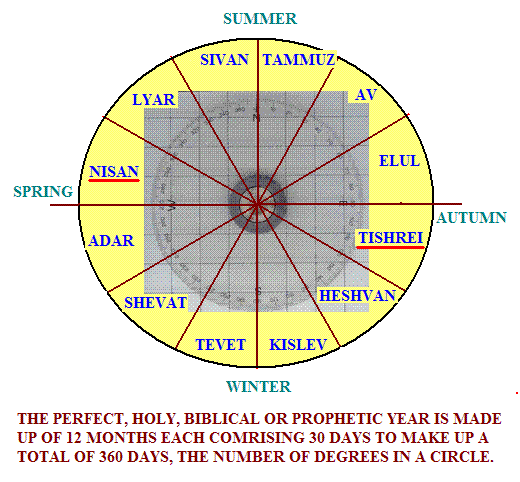 Twelve months of 29.53 days makes for a lunar year
of close to 354 days. This is 11.24 days short of the solar year which is 365.24 days.
So a calendar containing 12 lunar months
falls back 11.24 days every year. Hence the leap months added seven years out of 19.
Twelve months of 29.53 days makes for a lunar year
of close to 354 days. This is 11.24 days short of the solar year which is 365.24 days.
So a calendar containing 12 lunar months
falls back 11.24 days every year. Hence the leap months added seven years out of 19.
THE DISCOVERY OF METON IN 432 B.C.
19 YEARS = 235 LUNAR MONTHS.
AND SO THE LUNAR CYCLE = 29.53 DAYS.
THE 19 YEAR "METONIC CYCLE" IS DISCOVERED
WHICH PREDICTS THE LUNAR-SOLAR CALENDAR.
Meton of Athens
was a Greek mathematician, astronomer, geometer, and engineer.
He lived in Athens in the 5th century BCE.
This remarkable scholar
was doing what the Greeks did well. He was using Greek logic.
He was looking for patterns in nature in an attempt to quantify
the natural world. He was deliberately seeking
a deeper understanding of the rhyme and reason of things in the universe.
When he looked back at what the lunar calendar had
actually been doing down through the years he made a very important discovery.
Meton noticed that 19 solar years was exceedingly
close to being exactly 235 moons in length.
He saw that 19 solar years and 235 lunar months both add up to 6940 days.
This was a great discovery. And it had a wonderful application in the solar-lunar calendar. 7 extra months could be neatly inserted into the lunar calendar every 19 years. This would make the solar-lunar calendar predictable over 19 years. In 432 BC Meton introduced the 19-year Metonic cycle into the lunisolar Attic calendar.
This was truly a "Eureka" moment in the history of the solar-lunar calendar. The Metonic Cycle had been discovered! The discovery proved to be of great value. The solar-lunar calendar could be determined ahead of time.
THE CADENCE OF THE METONIC CYCLES.
THE METONIC CYCLE |
HEBREW SAGES PICK UP ON THE METONIC CYCLE AFTER THE TALMUDIC PERIOD.
IN 359 A.D. HILLEL II USES THIS TO CALCULATE AND SET FORTH THE HEBREW CALENDAR.
THIS IS THE CALENDAR NOW IN USE IN JUDAISM.
Here is the math on the Metonic Cycle.
The Hebrew calendar year was 12 months of 29 or 30 days with an extra month of Adar II added in
seven times in the 19 year Metonic Cycle.
A lunar cycle as could be easily calculated from the Metonic cycle was close to 29.53 days. So this made
for 12 months which averaged 29.53 days or 354.36 days.
But the solar year was 365.24 days.
So with each 12 month cycle the calendar would fall back
365.25 - 354.36 = approx. 11 days earlier.
This is why the calendar needed to be adjusted by adding in
an extra month of Adar seven times in the 19 year Metonic cycle.
The discovery of the Metonic Cycle by Meton was a great boon. It more or less predicted what an observer would see each spring. This 19 year calendar would predict whenever the new moon following Adar was going to fall short of the spring equinox. It would therefore predict the new moons quite accurately from month to month and predict the Nisan moon ahead of time and quite accurately from year to year.
The discovery of Meton of Athens was picked up by Jewish sages after the Talmudic period. The great Jewish scholar Hillel II incorporated the Metonic Cycle and calculated the lunar cycle as 29.530594 days and used this to set forth the Hebrew lunar calendar in 359 A.D..
The setting forth of a rigid Hebrew calendar had become a necessity in view of the Judaic priesthood adopting an elitist attitude and hiding this calendar information from God's covenant people. Y'hovah-God had always intended for family members to come to know Him and His Word and to be a nation of kings and priests before Him. But they had lost this somewhere down the line. And now they depended on the Rabbinical priesthood to answer all their questions. But after the fall of Jerusalem in 70 A.D. big problems arose. The Sanhedrin was outlawed by the Romans. This which made calendar authorizations across the nations very difficult for Jews in the Diaspora. They were unsure of when and how to place the annual holy days and festivals. But setting the calendar monthly by new moon sightings and annually by reckoning the month of Nisan as the first moon to achieve fullness after the Roman March 21 Spring equinox would not have been too difficult for them. Isolated Jewish heads of families with this simple knowledge could have set the Hebrew calendar by the sun and moon within a two day accuracy and do it quite reliably. The Karaite Jews and some Christians pursuing their Hebrew roots do this even today. See the text linked article below.
But there was this matter of convenience and absolute calendar unity that seemed to carry the day. This setting of the Hebrew calendar in 359 A.D. saved the authorities of the day from having to sight the new moon and set the month of Nisan every spring based on how they saw the moon come through to achieve fullness after the spring equinox.
But that was not all. There was the matter of politics with Rome. There is good evidence that Hillel II was under pressure from Rome/Byzantium to abide by their new seven day cadence. The Romans had an 8 day "Nundinal Weekly Cycle" running in their pure solar non-lunar calendar. When they went to Council of Niceae they changed it to a seven day week. Did they align their seven day week with the Jewish 7 day week? Why would they? As they gathered at Nicaea the principalities and powers of Rome and the embedded compromised Byzantine Church were in no way inclined to align their seven day cadence with the seven day cadence of the Jews. And when we track the Perpetual Calendar back to passion week which we know came in 32 A.D. and to a weekly cadence we know presented the Firstfruits Resurrection of Christ on Nisan 17 as the first day of the week, that being three days after the Nisan 14 Passover and crucifixion we know for a certainty that Hillel's calendar was forced out of synch with the earlier Jewish weekly cadence. In a word the Roman pagan cadence set by the Roman Church committees at Nicaea was forced on the calculated Hebrew calendar set forth by Hillel II, the one we have today.
NEWS FLASH!
THE CALCULATED HEBREW CALENDAR SET FORTH BY HILLEL II IN 359 A.D.
IS SLOWLY DRIFTING OFF TRACK. IT SOMETIMES PRESENTS THE FIRST DAY OF THE MONTH
ONE OR TWO DAYS EARLIER THAN THE ACTUAL NEW MOON SIGHTING. SOMETIMES, AS IN 2005
AND 2006 THE CALENDAR MONTH OF NISAN IS A MONTH LATER THAN THE TRUE NISAN,
THE MOON THAT PRESENTS THE FIRST FULL MOON AFTER THE MARCH 21 VERNAL EQUINOX.
IT IS ALSO A MONTH LATER THAN THE MOON THAT SEES THE BARLEY "ABIB" OR "RIPE".
THE SOLAR CALENDAR STORMS IN WITH THE ROMANS.
THEY PUSH THE LUNAR CALENDAR ASIDE.
The Romans had some different ideas for their calendar.
Julius Caesar established the Julian calendar which was strictly a solar calendar.
He wanted to lock in the days of the year based upon the solar cycle, period.
The starting time for his Roman calendar would be determined by the equinoxes.
Then he would set it off and running.
The Romans were all about forceful even brutish unification. For the Romans rigid establishment of the passage of the year was the main imperative. To them the lunar cycles in the passage of the moon were irrelevant. The Roman Calendar completely divorced the lunar cycles from any consideration whatsoever. Roman calendar months were named for the Caesars. And they were shackled to their place in the solar year. The calendar months were no longer connected to the celestial lunar cycles. 12 "months" were rigidly locked into the year of 365 days. An extra day was added in the leap years, (one in four). And so during the Roman era the Julian calendar set forth into history. It was a calendar year which averaged 365.25 days.
The solar Julian calendar of the Romans continued on in the west through the Byzantine and Medieval eras. The Islamic world and the Jewish communities in the Diaspora continued to use the lunar calendar. But as the centuries wore on in the west the old calendar of the Romans was wearing thin. It was coming seriously out of step with the solar cycles. By the 16th century the Julian calendar of the Romans was off by several weeks. Clearly something had to be done.
A refined solar calendar was first proposed by the Calabrian doctor Aloysius Lilius. This calendar came to the attention of Church authorities in the 16th Century. It was authorized by Pope Gregory XIII, after whom it was named. The new calendar was decreed by papal bull Inter gravissimas on 24 February 1582. This reform of the Julian calendar has not been changed since then. The Gregorian calendar is the most widely used calendar in the world today.
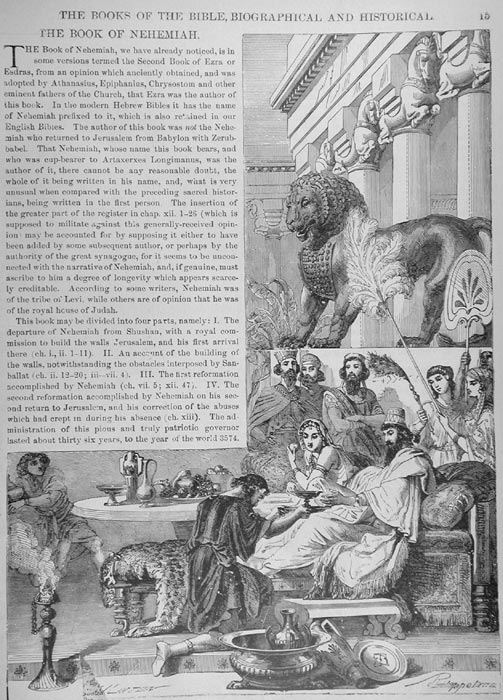
LUNAR CYCLES: USING THE HEBREW CALENDAR AS A
TIMEPIECE TO DETERMINE THE EXACT DAY IN WHICH
THE EDICT OF ARTAXERXES WAS GIVEN TO NEHEMIAH
TO START OFF THE SEVENTY WEEKS OF DANIEL.
The 20th year of Artaxerxes is well established from historical
records as being 445 B.C.
Nehemiah records that he went before the king "in the month
of Nisan". - Neh.chapter 2.
Sir Robert Anderson assumed that the edict came forth at the
very beginning of the month on the first day of the month
and at the time of the new moon.
This was traditionally the time
when royal edicts were made.
The arrival of the Passover moon for the exiles of Judah in Susa and out in the Persian Empire would have been a sombre time. Each year at this time they would see the Passover moon and remember what it meant to them. Something inside them would be grieving as they pondered just how far away from home they were. The pious among them, like Nehemiah, would have remembered the idolatry their nation had engaged in which had brought them down as a sovereign people and had sent them off into exile.
Using astronomical data we can know quite accurately when that Nisan moon came up in the 20th year of Ataxerxes. Sir Robert Anderson's data from the Astronomer Royal in 1877 is extremely accurate. The lunar data for 445 B.C. shows us that the true new moon for the Passover month of Nisan, (the first moon to come to fullness after the spring equinox), occurred in Jerusalem on March 13 at 07:09 hrs. 500 miles to the east over in Susa it would have occurred just a half an hour earlier. As we have seen, the new moon is not visible to the naked eye until it is at least 24 hours old. Nehemiah would not have seen the new moon until the following day, the morning of March 14 as the new moon arose with the sun in the eastern sky. Perhaps it was not seen until even the morning of March 15.
The new moon rises and sets with the sun. It is sometimes difficult to see especially in those days when the spring rains come or clouds obscure the thin crescent of the new moon as it arises in the eastern sky.
Thus the 1st day of Nisan for the year 445 B.C. was probably on March 14th. This is precisely as Sir Robert Anderson had stated. As we shall discover in article 8 the consensus of both the solar and lunar cycles is that the actual edict came a day later on March 15 of 445 B.C. and this was probably on Nisan 2 or 3. This was a day or so later than the March 14 and Nisan 1 date that Sir Robert Anderson had calculated. Is this a big discrepancy? Not at all. Our calculations later on in this study will have us hitting near a bullseye. We shall be hitting the mark within just one or two days after a long passage of 173,880 days or 476 years!
THE LUNAR CYCLES, THE HEBREW MONTH OF NISAN, AND THE
DETERMINATION OF THE EXACT DAY IN WHICH JESUS CHRIST
PRESENTED HIMSELF TO HIS OWN PEOPLE IN JERUSALEM AS
'MESSIAH THE PRINCE' TO CONCLUDE THE FIRST 69 WEEKS
OF THE SEVENTY WEEKS OF DANIEL.
So much for the beginning date of the 70 weeks/69 weeks.
Let us now turn our attention to the terminus
of the 69 weeks timeline.
The new moon of Nisan (the Paschal Moon) of 32 A.D.
was March 29 at approx. 8 p.m. UTC or 11 p.m. Jerusalem time
according to U.S Naval Observatory data.
This is similar to the 22 hrs 57 min time for the new moon
Sir Robert Anderson had received
from the Astronomer Royal, Greenwhich Observatory, in 1877.
Since the Rabbis in Jerusalem in 32 A.D. (or their observers from
wider Israel) would
not have seen the new moon with the naked eye
until it was at least 24 hour old then there is no way
they could have seen the new moon
on the following morning of March 30th when it was just 7 hours old
nor the following evening when it was 19 hours old
and before it set with the sun.
The morning of March 31st
would have given them their first opportunity to see
the new moon. By that time it would have been 31 hours old.
Accordingly they would have called March 31st the first Day of
the Passover month of Nisan.
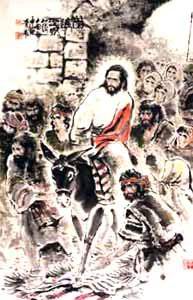
The 10th of Nisan, Palm Sunday and
four days before the crucifixion of our Lord, the date of His
"Triumphal Entry" into Jerusalem as
"Messiah the Prince" or "Messiah the King" would
therefore have been 9 days later on April 9th of 32 A.D..
This tenth day of Nisan was the day when the Passover lambs began to be
presented to the priests. They had to be accepted as spotless
and without fault before they could be sacrificed.
This was that crucial day for which all of Israel should have been watching.Their Messiah was the promised Sacrifice Lamb.
He was prophesied to appear on this very day.
Alas, the people of Israel were not watching. They had gone with rabbinical Judaism and taken the road down into religious legalism. They had drifted away from a true devotional faith in YHVH, the God who was, is, and evermore shall be. Faith in God had always been a matter of the heart. They had turned it into a head trip and merely an exercise in legalism. They did not recognize their Suffering Servant when he came amongst them. There He was, teaching, healing the sick, and casting out evil spirits. But they did not recognize Him.
As for diligence in the matter of the prophecy of the 70 weeks the scholars and scribes should have been able to count out 69 weeks (sevens) of years and lay out a timeline from the Nisan month and the year Artaxerxes's edict which Daniel had said came in the 20th year of his reign. This had been given to Nehemiah at the beginning of the Nisan moon of 445 B.C.. Unfortunately Rabbinical Judaism in the first century A.D. no longer held to a literal interpretation of scripture. They lacked the diligence in devotion and knowledge to recognize their Messiah. He came into Jesuslem riding on a donkey precisely as prophesied. - Zech.9:9 It was on that day, (and that day only), that Jesus/Yeshua entered Jerusalem at the head of a royal procession. He presented Himself to His people as 'Messiah the Prince'. And yet how few there were there to greet Him. When Jesus rode into Jerusalem on that first Palm Sunday He lamented,
"If you, even you, had only known on this day what would bring you peace -- but now it is hidden from your eyes. The days will come upon you when your enemies will build an embankment against you and encircle you and hem you in on every side. They will dash you to the ground, you and the children within your walls. They will not leave one stone on another, because you did not recognize the time of God's coming to you. -Luke 19:42Some no doubt were indeed watching. They knew the date of this epic day had arrived. And so they were waiting for His appearance. These people knew their Messiah. There He was! He was entering the city through the Eastern Gate! They greeted Him with shouts of "Hosanna!" as He came into Jerusalem riding upon a donkey. They laid palm branches out before Him as their victorious coming King. But they were not a quorum. The learned priests, the Pharisees, the Sadducees, and the High priest himself were not watching. They had access to all the data. They had the very same book of Daniel and chapter nine as we are studying right now. And they could count the years. Had not the Magi, gentile kings from the east, come to bring gifts to Jesus at His birth in Bethlehem years before? But the Pharisees and Sadducees were not inclined to treat God's Word with the reverence which it was due. They had not done their homework.
The Pharisees were to be the watchmen of Israel.
And here it was, their own Messiah was at the gate.
And they were not keeping watch.
What can be said about us in the church today? Have we taken time to aquaint ourselves with our part of the seventy weeks of Daniel. Do we know something of the the 70th week of Daniel and the final seven years of this age? Have we checked out what the Bible says will happen at its beginning, its midpoint, and at the end? All we need is a rough thumbnail sketch. Shouldn't we get a basic understanding of what will happen? And wouldn't it be wise of us to make the preparations of heart that we are being called to do?
On to Section 6
The 69 WEEKS:
A SPAN of 173,880 EARTH DAYS